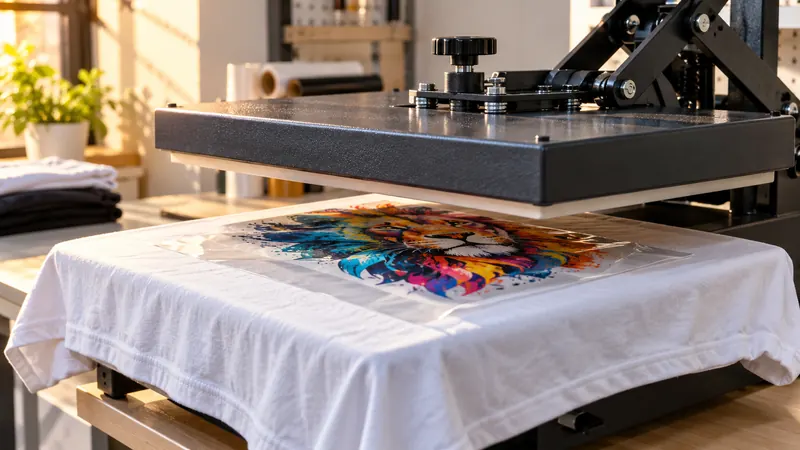
Do I Need a Heat Press for DTF? Usually, yes. A heat press is the most reliable way to apply ready-to-press DTF transfers because it provides controlled heat, timed contact, and adjustable pressure across the transfer. A household iron may work for some small projects, but it does not provide the same consistent coverage or pressure control.
You do not necessarily need a DTF printer. Many suppliers sell finished DTF transfers that are ready for application. In that setup, your main equipment is a suitable flat heat press, along with the garment and any protective materials specified by the transfer supplier.
Why a Heat Press Is Used for DTF Transfers
DTF transfers contain printed ink and adhesive powder that must bond to the garment under specific application conditions. The exact temperature, pressing time, pressure, peel method, and finishing instructions depend on the transfer supplier and the particular DTF system.
A heat press helps provide:
- A controlled set temperature.
- A defined pressing time.
- Adjustable pressure.
- Broad contact across the transfer.
- Repeatable positioning and application.
The controller’s displayed temperature is a setpoint, not proof that every part of the platen has reached the same actual surface temperature. Press condition, platen contact, garment construction, and transfer instructions all affect the result.
Can You Apply DTF Without a Heat Press?
Sometimes, but the alternative is less predictable. A household iron can apply heat to a transfer, yet it may leave areas with insufficient heat or pressure. The iron’s small contact area also makes it difficult to cover a larger design without moving the tool and creating inconsistent results.
A handheld press may be usable for a small DTF design if the transfer manufacturer allows that method. It still requires careful movement and firm, consistent coverage. A mini heat press has similar limitations. These tools can be practical for occasional small work, but they are less suitable for repeatable production.
For a reliable application, use a flat heat press with:
- A platen large enough to cover the design conveniently.
- Temperature and timer controls.
- Adjustable pressure.
- A flat loading surface that lets the artwork sit clear of seams, pockets, zippers, and thick hems.
A larger platen provides more nominal working area, but it does not automatically prove better temperature uniformity or transfer performance. The transfer still needs to fit on a smooth, pressable section of the garment.
Do You Need a DTF Printer?
No. A DTF printer is required only if you plan to produce transfers yourself. Many apparel decorators order completed transfers from a DTF supplier. The supplier prints the artwork onto film and applies the adhesive powder system before shipping the transfer for garment application.
Producing DTF transfers in-house involves more than owning a printer. The workflow can include:
- DTF-compatible ink and film.
- Powder application.
- Adhesive powder curing.
- Ventilation and safe handling practices.
- Printer maintenance and white-ink management.
- A method for transferring the finished design to the garment.
Equipment requirements vary by printer, transfer system, and curing method. Follow the documentation for the exact products rather than treating every DTF setup as interchangeable.
Use the Transfer Supplier’s Instructions
There is no universal DTF setting that applies to every transfer. Suppliers may use different films, inks, adhesive powders, curing systems, and finishing instructions. They may also specify different peel categories, such as hot peel, warm peel, or cold peel.
Before pressing, locate the instructions for the exact transfer. Confirm:
- Required temperature.
- Pressing time.
- Pressure level or pressure description.
- Whether the carrier should be peeled hot, warm, or cold.
- Whether a finishing press is required.
- Which protective sheet or covering material is approved.
- Whether the transfer is suitable for the garment.
Terms such as light, medium, or firm pressure are relative instructions unless the supplier defines them more precisely. A pressure knob position on one press does not have a universal meaning on another machine.
Basic Process for Applying a Ready-to-Press DTF Transfer
The following process is a general workflow. The exact settings and peel instructions must come from the supplier of the transfer.
- Check the garment. Confirm the fabric type, care information, surface condition, and suitability for the transfer. Look for seams, pockets, zippers, buttons, or other raised areas that could prevent flat contact.
- Prepare the press. Set the machine according to the transfer supplier’s instructions. Allow the press to reach its displayed set temperature before starting the application.
- Position the garment. Load it so the artwork rests on a flat portion of the platen. Remove wrinkles and keep thick garment features away from the design area where possible.
- Position the transfer. Place the printed side against the garment with the carrier film facing upward, unless the supplier provides a different arrangement.
- Press the transfer. Apply the specified temperature, time, and pressure. Avoid changing one variable casually to compensate for another.
- Peel the carrier. Wait for the exact hot, warm, or cold peel condition listed by the supplier. Peeling at the wrong point can affect adhesion.
- Finish the application if instructed. Some DTF systems require a second application step or a specified covering material. Follow the supplier’s instructions instead of automatically repressing the design.
- Inspect the result. Check the edges and fine details for adhesion. If the transfer has lifted or failed, review the complete process before increasing heat or pressure.
Why DTF Transfers Fail on a Heat Press
A heat press does not guarantee a successful DTF application by itself. Transfer problems can result from the product, garment, settings, contact, or handling.
| Symptom | Possible areas to check |
|---|---|
| Edges lift after pressing | Supplier settings, pressure, peel timing, garment compatibility, uneven contact, or contamination. |
| Parts of the design do not adhere | Seams, pockets, wrinkles, platen contact, insufficient coverage, or incorrect settings. |
| Carrier film does not release correctly | The transfer’s specified peel condition and the actual temperature or timing of the process. |
| Design appears damaged after a second press | Unapproved repressing, excessive heat, unsuitable covering material, or an incorrect finishing procedure. |
| Transfer works in one area but fails in another | Uneven contact, garment geometry, pressure distribution, or possible platen-temperature variation. |
Do not assume the press is defective based on one failed shirt. First verify the transfer instructions, garment compatibility, placement, contact, pressure, timing, and peel method. If failures consistently occur in one platen area, temperature testing with multiple measurement locations may help separate heat variation from pressure or contact problems. A single center reading cannot establish full-platen uniformity.
Can Any Heat Press Be Used for DTF?
A flat heat press may be physically suitable for many ready-to-press DTF applications, provided it can meet the exact transfer instructions and produce appropriate contact. That does not mean every press is proven to be optimized for every DTF product.
Check the machine’s concrete specifications and operating condition:
- Temperature control and timer operation.
- Platen dimensions relative to the transfer.
- Pressure adjustment.
- Platen alignment and contact.
- Electrical requirements for the specific model.
- Condition of the upper platen, lower pad, and protective materials.
Clamshell, swing-away, and slide-out presses use different loading arrangements. The press style does not by itself establish better DTF results. The useful question is whether the machine allows the garment and transfer to sit flat and whether it can follow the exact application instructions.
Safety Points for DTF Pressing
DTF application involves a hot platen and heated garments. Keep hands away from the pressing surfaces, use appropriate heat-resistant handling methods, and follow the machine manual. Do not leave an operating press unattended unless the manufacturer specifically permits that operating mode.
Use suitable ventilation for the transfer process and follow the transfer supplier’s handling guidance. If the press produces unexplained smoke, sparking, melted wiring, or a persistent burning electrical odor, stop using it, disconnect power when safe, and contact the manufacturer or a qualified technician.
What Equipment Do You Actually Need?
For applying purchased DTF transfers, the basic setup is usually:
- A suitable flat heat press.
- Ready-to-press DTF transfers.
- Compatible garments or other approved substrates.
- Any supplier-specified protective sheet or covering.
- A clean, flat work area.
A DTF printer is optional if transfers are purchased from a supplier. An iron or handheld press may be workable for limited small designs, but a heat press is the practical choice for repeatable application because it gives you controlled time, temperature, pressure, and coverage.
Frequently Asked Questions
Can I use an iron instead of a heat press for DTF?
An iron may work for some small transfers if the supplier permits it, but coverage and pressure are difficult to keep consistent. A heat press is more reliable for repeatable results.
Do I need a special DTF heat press?
Usually, you need a suitable flat heat press rather than a machine marketed with a specific DTF label. It must be capable of following the exact transfer instructions and providing suitable contact across the design.
Can I use a mini heat press for DTF?
A mini press may be suitable for a small design when the supplier allows it. You must cover the transfer carefully and maintain consistent contact. Larger designs may be difficult to apply evenly with a small platen.
Do I need to cure DTF powder if I buy finished transfers?
Finished transfers normally arrive with the printing and adhesive-powder stages completed by the supplier. If you produce transfers yourself, you need a curing method appropriate for that DTF system.
Do all DTF transfers use the same temperature and peel method?
No. Temperature, pressing time, pressure, peel timing, and finishing steps can vary. Use the instructions supplied for the exact transfer.
A heat press is not always required for a one-off DTF experiment, but it is the dependable equipment for regular application. If you buy finished transfers, focus on a flat press that can follow the supplier’s specifications and provide stable contact across the artwork.
