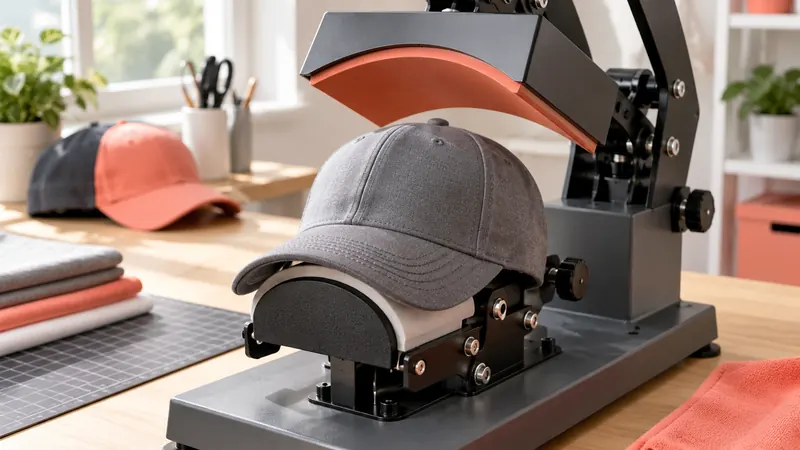
A heat press is a machine that applies controlled heat, time, and pressure to attach a transfer or decorate a suitable blank. The machine usually has a heated upper platen and a lower platen that supports the garment, fabric, or other item. During a press cycle, heat activates adhesive or transfers dye into a compatible surface while pressure helps the materials make consistent contact.
Heat presses are used for HTV, DTF transfers, sublimation, transfer paper, plastisol transfers, patches, rhinestone transfers, and other heat-applied products. The machine itself does not determine the correct application settings. Temperature, pressing time, pressure, peel method, and substrate compatibility come from the specific transfer and blank instructions.
How a Heat Press Works
A typical heat press brings the upper platen to a selected controller setting. The operator places the transfer and substrate between the platens, closes the press, and applies pressure for the specified time. The cycle ends when the timer expires, although the operator may need to open the machine manually unless it has an auto-open function.
Each part of the cycle serves a different purpose:
- Heat: Activates adhesive, softens a transfer layer, or enables sublimation dye to bond with a compatible coating or polyester material.
- Time: Determines how long the transfer and substrate remain exposed to the process conditions.
- Pressure: Helps the transfer contact the surface. The required amount depends on the transfer, substrate, machine, and surface geometry.
These variables work as a system. Increasing the temperature, extending the time, or applying more pressure does not automatically correct an application problem. Excessive heat or pressure can damage a garment, alter a transfer finish, cause dye migration, flatten puff effects, or affect a coated blank.
What the Heat Press Temperature Setting Means
The temperature shown on the controller is a set temperature or displayed temperature. It does not prove that every part of the platen surface has reached that exact temperature. The actual surface temperature can be affected by the machine’s sensor, heating system, recovery behavior, measurement method, and location on the platen.
A stated temperature range also does not establish temperature accuracy or uniform heating. Similarly, construction details such as multiple heating elements, an aluminum platen, a thick platen, or a coating do not independently prove that the entire surface heats evenly.
For process settings, follow the instructions for the exact transfer product. A general recommendation for one HTV, DTF film, sublimation blank, or transfer paper may be unsuitable for another product in the same category.
What Pressure Means on a Heat Press
Pressure describes how firmly the upper and lower platens press against the transfer and substrate. Manufacturers and transfer suppliers may use terms such as light, medium, or firm pressure. These descriptions are relative and do not represent universal PSI values.
A pressure knob position also does not have the same meaning on every machine. The mechanism, platen spacing, substrate thickness, and machine adjustment all affect the result. A pressure display may show a machine-specific value, but the display alone does not prove calibrated pressure or equal pressure across the platen.
Good contact matters because seams, collars, pockets, zippers, buttons, thick hems, and curved surfaces can prevent the transfer from sitting flat. A transfer may fail in one area because of poor contact rather than a temperature problem.
Common Types of Heat Press Machines
Clamshell Press
A clamshell press has an upper platen that opens upward from a hinge near the rear of the machine. The upper assembly remains connected to the base while it opens and closes. The loading area and available clearance vary by model.
Swing-Away Press
A swing-away press moves the upper heating assembly laterally away from the lower platen. This changes the loading position and the space available above the garment. The mechanical design does not, by itself, prove that the press is safer or produces better transfers.
Slide-Out or Drawer Press
A slide-out press has a lower platen or loading surface that moves outward. This changes where the operator places the garment or blank during loading. The exact movement and clearance depend on the machine design.
Auto-Open Press
An auto-open press releases or opens after the timed cycle according to its design. Auto-open describes a specific automatic action. It does not necessarily mean that the machine adjusts pressure, loads the substrate, or performs every part of the process automatically.
Portable and Mini Presses
Portable and mini presses have smaller heating surfaces and are often used for small designs, narrow areas, or locations that are difficult to reach with a full-size platen. Their working area may require several placements for a larger design. Multiple placements can introduce alignment and heat-exposure challenges.
Specialty Presses
Hat presses, mug presses, tumbler presses, and other specialty machines use shaped platens or heaters for curved objects. A flat platen and a curved attachment are not interchangeable. The blank’s dimensions, shape, coating, and the attachment’s compatibility all matter.
What Can a Heat Press Apply?
A heat press can apply many transfer types, provided the transfer and substrate are compatible. The exact product instructions control the temperature, time, pressure, peel method, and any finishing press.
| Transfer method | How it uses a heat press | Important limitation |
|---|---|---|
| HTV | Heat activates the adhesive on heat transfer vinyl so it bonds to a suitable substrate. | Different HTV products can have different settings, peel instructions, layering rules, and material compatibility. |
| DTF | A printed film transfer bonds to a garment or other approved substrate through heat and pressure. | Temperature, time, pressure, peel method, and repress instructions vary by transfer supplier and product. |
| Sublimation | Dye transfers from printed paper into a compatible polyester surface or sublimation coating. | The item must have a suitable polyester content or sublimation-ready coating. Heat tolerance alone is insufficient. |
| Transfer paper | An inkjet or laser-printed image transfers to a compatible surface. | Inkjet paper, laser paper, HTV, DTF, and sublimation paper use different processes and should not share settings automatically. |
| Patches | Heat activates an adhesive backing on patches intended for heat application. | Some patches require sewing, pressure-sensitive adhesive, hook-and-loop attachment, or another method instead. |
| Rhinestone transfers | Heat activates the adhesive holding the stones to the substrate. | The carrier, adhesive, stones, and application instructions can vary between products. |
Materials and Surfaces Require Compatibility Checks
A heat press can reach a temperature that a material cannot safely tolerate. Heat resistance does not automatically make a surface suitable for every transfer method.
- Polyester: Many polyester garments can accept selected transfers, but heat sensitivity, dye behavior, garment construction, and transfer requirements must be checked. Dye migration may affect some projects.
- Nylon: Nylon fabrics and coatings vary. Standard HTV or DTF is not automatically suitable for every nylon item. Use a transfer specifically approved for the material when required.
- Leather and synthetic leather: Genuine leather, PU leather, coated materials, and other leather-like surfaces can respond differently to heat and pressure. Follow the patch or transfer supplier’s instructions.
- Canvas: Fiber content, weave, coating, and finish affect heat tolerance and adhesion.
- Wood: Unfinished wood, painted wood, engineered wood, and sublimation-ready blanks are different surfaces. A heat-tolerant wood item is not automatically compatible with sublimation.
- Hats: Curved crowns and seams can prevent a flat platen from making uniform contact. A suitable cap platen or specialty press may be required for the intended transfer.
- Mugs and tumblers: Curved items need an appropriate heater or attachment that matches their size and shape. A flat press cannot automatically provide contact around a cylinder.
Important Heat Press Terms
- Platen: The heated upper surface or the lower support surface between which the item is pressed. Usage varies by manufacturer, so the manual’s terminology takes priority.
- Nominal platen size: The stated dimensions of the working surface. This does not guarantee that a design of the same dimensions will fit comfortably around seams, pockets, or platen edges.
- Clearance: The available opening or adjustment range of a machine. It does not establish universal compatibility with every item of that thickness.
- Carrier sheet: A clear or protective layer that holds some transfers during application. Its removal timing depends on the exact product.
- Hot peel, warm peel, and cold peel: Different carrier-removal instructions. The correct method must come from the transfer supplier.
- Displayed temperature: The value shown by the controller, which may differ from the actual temperature at different platen locations.
- Testing: Measuring or comparing machine behavior, such as temperature at several locations.
- Calibration: Adjusting a system against a reference. A temperature reading alone is a test, not proof that the press has been calibrated.
What a Heat Press Cannot Do
A heat press cannot make an incompatible transfer adhere reliably to an unsuitable surface. More heat is not a universal solution for poor adhesion, faded sublimation, peeling HTV, or a transfer that does not contact the garment evenly.
The machine also cannot guarantee uniform results simply because it has a large platen, high wattage, multiple heating elements, automatic functions, or a broad temperature range. Performance depends on the machine’s condition and setup, the transfer product, the substrate, the contact area, and the application instructions.
If a transfer fails, check the exact product instructions first. Confirm the substrate, displayed temperature, pressing time, pressure, peel timing, placement, and surface contact before assuming that the press itself is defective.
Basic Heat Press Safety
Heat presses combine high temperatures, electrical power, and mechanical pressure. Keep hands and loose materials away from the closing area and hot platens. Use a suitable workspace, follow the machine manual, and handle heated blanks with appropriate protection.
Do not bypass grounding, thermal protection, fuses, or other safety devices. Avoid unsuitable adapters or electrical modifications. If the press produces unexplained smoke, sparks, a burning electrical odor, melted wiring, or abnormal controller behavior, stop using it, disconnect power when safe, allow it to cool, and contact the manufacturer or a qualified technician.
Frequently Asked Questions
Is a heat press the same as an iron?
No. An iron is operated by hand and may provide variable contact, temperature, and pressure. A heat press uses a machine-controlled platen and timed cycle. The two tools are not automatically interchangeable for a particular transfer.
Do all heat presses use the same temperature?
No. The correct setting depends on the exact transfer, substrate, pressing time, pressure, peel method, and machine instructions. There is no universal temperature for all HTV, DTF, sublimation, patches, or transfer paper.
Does a heat press work on every shirt?
No. Shirt fiber content, dye behavior, finish, construction, and heat tolerance affect compatibility. The garment instructions and transfer manufacturer’s guidance should be checked together.
Can a heat press apply sublimation to any object?
No. Sublimation requires a compatible dye system and a suitable polyester surface or sublimation coating. An object that tolerates heat is not automatically sublimation-ready.
Does a larger heat press always perform better?
No. A larger platen provides more nominal working area, but it does not by itself prove better heating, pressure, accuracy, or transfer quality. Size should match the projects, blank geometry, workspace, and machine requirements.
