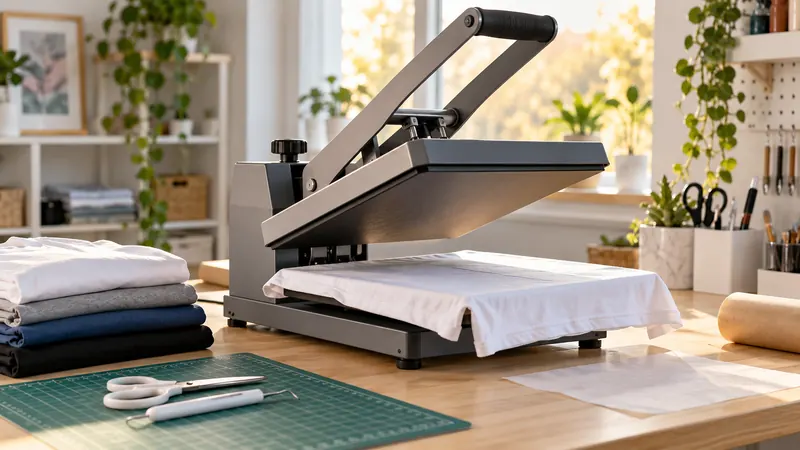
A home heat press can turn a spare corner into a practical setup for shirts, tote bags, pillows, hats, and small personalized gifts. The catch is that “home use” covers very different projects. Someone pressing occasional names onto shirts needs a different machine from a crafter handling mugs, caps, tumblers, and plates. A large platen, automatic release, adjustable pressure, or a compact handheld format can each matter, but no single feature settles the decision.
Common mistakes include buying a mini press for full-shirt designs, treating a flat press as a substitute for a hat or mug attachment, and assuming a higher wattage rating proves faster heating. The useful details are more concrete: pressing area, temperature and timer controls, pressure adjustment, opening mechanism, included attachments, electrical information, and the amount of workspace the machine needs. For most home users seeking a primary machine, the HTVRONT Auto Heat Press Machine 15×15 is the strongest overall fit because it combines a full-size pressing area with automatic pressing and release.
Different buyers will still land on different picks. A multifunction machine makes sense for a home setup covering drinkware and caps, while a 12×10 press offers a more manageable middle ground for apparel. Mini presses are better suited to small designs and tight areas, and the Fancierstudio focuses on straightforward manual control. The comparison below separates those roles so the size and feature differences are clear before you read the detailed reviews.
Quick Answer
- Best Overall: HTVRONT Auto Heat Press Machine 15×15 for a full-size home press with automatic pressing and release.
- Best With Attachments: Seeutek 8 in 1 Heat Press Machine for shirts, hats, mugs, tumblers, plates, mouse pads, and coasters.
- Best Manual Option: Fancierstudio Digital Heat Press 15×15 for adjustable pressure and electronic time and temperature controls.
- Best for Small Designs: Cricut EasyPress Mini LT for precision work on small or unusually shaped areas.
Best Heat Press for Home Use Comparison Table
| Product | Best For | Press Type | Pressing Area | Automation or Attachments |
|---|---|---|---|---|
| HTVRONT Auto Heat Press Machine 15×15 | Overall home use | Automatic flat press | 15×15 inches | Automatic pressing and release |
| Seeutek 8 in 1 Heat Press Machine | Mixed home projects | 360-degree swing-away, multifunction | 15×15 inches | Hat, mug, tumbler, plate, mouse pad, and coaster attachments |
| Fancierstudio Digital Heat Press 15×15 | Manual shirt pressing | Manual flat press | 15×15 inches | Adjustable pressure |
| HTVRONT Auto Heat Press 2 | Adjustable automatic pressing | Automatic flat press | 15×15 inches | Adjustable pressure and automatic release |
| HTVRONT H10 12×10 Heat Press | Apparel with pressure display | Portable flat press | 12×10 inches | Pressure, time, and temperature display |
| Cricut EasyPress SE | Portable apparel projects | Handheld flat press | 12×10 inches | Heat Guide support |
| Cricut EasyPress Mini LT | Small designs and detail work | Mini handheld press | Mini heat plate | Precision tip and insulated base |
| Calogy Mini Heat Press | Small craft projects | Mini handheld press | 2.87×4.43 inches | Three temperature levels and auto-off |
| HTVRONT Mini Heat Press | Portable small transfers | Mini handheld press | Mini heat plate | Three heat settings and insulated base |
The reviews below put each machine in context, with attention to the projects it supports and the compromises that matter in a home workspace.
1. HTVRONT Auto Heat Press Machine 15×15 – Best Overall

The HTVRONT Auto Heat Press Machine 15×15 is the most complete match for a home user who wants a primary flat press without manually holding the upper platen through each timed cycle. Its 15×15-inch stated pressing area leaves room for common shirt designs, totes, décor pieces, and other flat projects. The drawer-style board slides into position, then the listed automatic mode presses and releases the project after the cycle. That mechanical arrangement gives the machine a clear identity among the manual presses here.
The controls include four fast modes, two custom modes, and an auto mode. The listing also states that the machine adjusts for project thickness up to 1 inch, while the auto-off feature activates after 15 minutes without use. Heat-up figures are published as seller claims, including reaching 320°F in around four minutes, so they should be treated as listing information rather than independent testing. For a household setup that moves between shirts, totes, and smaller hard-surface projects, the combination of a full-size platen and automatic release is the key attraction.
Pros
- Provides a stated 15×15-inch pressing area.
- Automatically presses and releases after the timed cycle.
- Includes four fast modes, two custom modes, and an automatic mode.
- Lists compatibility with apparel, wood signs, and ceramic coasters up to 1 inch thick.
- Includes a drawer-style board and 15-minute automatic shutoff.
Cons
- The published information does not identify a temperature-accuracy tolerance.
- It is a flat press, so the supplied information does not establish dedicated mug or hat capability.
This is the clearest pick for buyers wanting one full-size home machine with automatic operation. A multifunction model fits better if mugs, tumblers, plates, and caps are central to the project list, while a manual press may appeal to shoppers who prefer direct control over every cycle.
To buy this product, click here.
2. Seeutek 8 in 1 Heat Press Machine – Best With Attachments

The Seeutek takes a different route from a single-purpose shirt press. Its package includes a 15×15-inch flat press along with listed hat, mug, tumbler, and plate presses. The product information also identifies support for mouse pads and coasters, giving a home user a way to work across several object types without buying separate equipment for every project. That breadth is the reason to look at it, not simply the number in its name.
The main press uses a 360-degree swing-away design and a slide rail for changing between attachments. A digital controller provides a stated temperature range of 0 to 482°F and a timer range of 0 to 999 seconds. The supplied package lists 6-ounce and 11-ounce mugs, 12-ounce and 17-ounce cone mugs, a 30-ounce tumbler press, and 5- and 6-inch ceramic plate presses. Those details make it more useful for a mixed craft menu, though every attachment adds another fit and setup decision.
Pros
- Includes a stated 15×15-inch flat pressing area.
- Lists hat, mug, tumbler, plate, mouse pad, and coaster applications.
- Includes a 360-degree swing-away mechanism and slide-out base.
- Provides digital temperature and timer controls.
- Lists 6-ounce and 11-ounce mugs, cone mugs, a 30-ounce tumbler, and two plate sizes.
Cons
- The multiple attachments require more storage and setup space than a single-function press.
- The published information does not identify the dimensions or weight of the assembled machine.
Choose this model if your home projects extend beyond flat apparel and the listed attachments match the blanks you plan to use. A single-function HTVRONT or Fancierstudio makes more sense for shirts and totes alone, where the extra attachment set would go unused.
To buy this product, click here.
3. Fancierstudio Digital Heat Press 15×15 – Best Manual Option
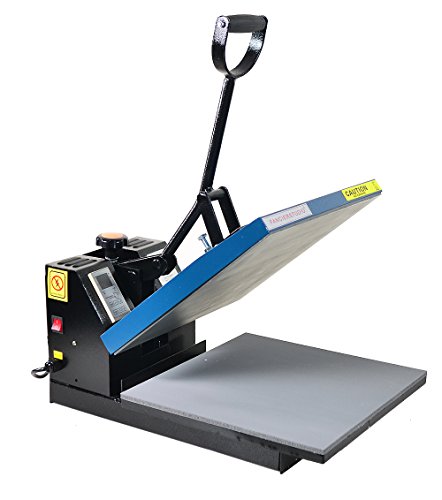
The Fancierstudio Digital Heat Press 15×15 keeps the core setup straightforward. It has a stated 15-by-15-inch heat press sheet, electronic time and heat control, and adjustable pressure. For home users who want a conventional flat press for shirts and other flat items, those are the controls that deserve attention. The supplied information does not describe automatic pressing or release, so the operator remains involved in the opening and closing process.
The listed temperature range runs from 0 to 699°F, with a timer range of 0 to 999 seconds. It also includes a silicon-gel base board and identifies a Teflon coating on the heat platen. Those materials and controls are published specifications, not a guarantee of transfer quality or measured temperature uniformity. The listing states 110 volts and 1,800 watts, which can help a buyer compare electrical information with other household equipment, though wattage alone does not establish heating speed.
Pros
- Provides a stated 15×15-inch heat press sheet.
- Includes electronic time and temperature controls.
- Offers adjustable pressure.
- Lists a 0 to 999-second timer range.
- Includes a silicon-gel base board and Teflon-coated heat platen.
Cons
- The supplied information does not identify an automatic release function.
- The published specifications do not state a heat-up time or temperature-accuracy tolerance.
This model suits buyers who want a full-size manual press and clear electronic controls without the attachment system of the Seeutek. Buyers who prefer automatic operation should move up to the HTVRONT automatic models, while shoppers needing curved or drinkware attachments should look elsewhere.
To buy this product, click here.
4. HTVRONT Auto Heat Press 2 – Best Adjustable Automatic Option

The HTVRONT Auto Heat Press 2 builds on the automatic flat-press format with a separately stated pressure adjustment system. The listing says pressure can be adjusted up to 80 kilograms, or 170 pounds, and describes the machine as suitable for DTF projects. That numeric claim belongs to the product listing and should not be confused with an independently verified pressure measurement. Mechanically, the useful distinction is that the operator has a stated pressure adjustment rather than relying only on the machine’s automatic cycle.
This model also provides a 15×15-inch pressing area and increased height for items listed up to 4.5 centimeters, or 1.77 inches. The automatic mode presses after the user sets the parameters, then releases when the timer ends and sounds a reminder. The screen angle can be adjusted through seven positions from 0 to 75 degrees. Those features make the control area and clearance different from a basic manual press, although the supplied information does not establish performance with every thick item or transfer type.
Pros
- Provides a stated 15×15-inch pressing area.
- Includes adjustable pressure listed up to 80 kilograms or 170 pounds.
- Automatically presses and releases after the timed cycle.
- Lists clearance up to 4.5 centimeters or 1.77 inches.
- Includes an angle-adjustable screen and 15-minute automatic shutoff.
Cons
- The supplied pressure figure is a published claim, not a Heat Press HQ measurement.
- The published information does not identify the machine’s overall footprint or weight.
This is a useful alternative for buyers who want automatic operation but place more emphasis on adjustable pressure and stated clearance. The standard HTVRONT automatic model is simpler if those adjustments are unnecessary, while the Seeutek is the better fit for projects involving listed drinkware and cap attachments.
To buy this product, click here.
5. HTVRONT H10 12×10 Heat Press – Best Pressure-Display Option

The HTVRONT H10 offers a middle path between a large tabletop press and a small detail tool. Its stated 12×10-inch heat plate provides a defined working area for shirts, hoodies, pillows, bags, and décor projects. The most unusual feature here is the built-in pressure sensor and display, which shows pressure data alongside time and temperature. The display provides information during operation, but the listing does not provide a pressure-accuracy tolerance.
A dual-handle layout gives the operator two grip points, while the product information identifies an insulated safety base and an audible completion signal. The listing states that the machine reaches 212°F in its first minute, a seller-published heating claim rather than independent testing. Its 15-minute auto-shutoff adds a defined idle feature. Compared with a 15×15 automatic press, this model offers a smaller stated area and manual handling, but it may fit a home user who values displayed pressure information.
Pros
- Provides a stated 12×10-inch heat plate.
- Displays pressure, time, and temperature information.
- Uses a dual-handle format.
- Lists support for shirts, hoodies, pillows, bags, and décor projects.
- Includes an audible completion signal, insulated base, and 15-minute auto-shutoff.
Cons
- The published information does not state a pressure-display accuracy tolerance.
- Its 12×10-inch area is smaller than the 15×15-inch area on the full-size presses in this roundup.
Consider this press for apparel-focused home work where the pressure display is more useful than automatic release. A 15×15 machine is a better match for larger designs, while a mini press is more appropriate for tiny areas and curved edges.
To buy this product, click here.
6. Cricut EasyPress SE – Best Portable Apparel Option

The Cricut EasyPress SE uses a handheld flat-press format with a stated 12×10-inch heat plate. That size places it closer to the HTVRONT H10 than to the 15×15 machines, but its controls and guidance are presented differently. The listing identifies a ceramic-coated heat plate, controlled temperatures up to 400°F, and an easy-to-hold handle. It is also described as portable and lightweight, although the supplied information does not give a numerical weight.
The product information lists compatibility with major brands of iron-on materials, Infusible Ink, and sublimation products. It also points users toward the Cricut Heat Guide for time, temperature, material, and blank guidance. That guide can be useful for a buyer who wants process instructions connected to the listed applications, but it does not make the press automatic. The machine remains a manually positioned handheld press, so design size and repeated repositioning deserve attention.
Pros
- Provides a stated 12×10-inch heat plate.
- Lists controlled temperatures up to 400°F.
- Includes a ceramic-coated heat plate and insulated safety base.
- Lists support for iron-on materials, Infusible Ink, and sublimation products.
- Provides access to the Cricut Heat Guide for listed materials and blanks.
Cons
- The handheld format does not provide automatic pressing or release.
- The supplied information does not state a numerical machine weight or overall footprint.
This press fits home users who want a manually positioned 12×10 machine and value the listed Heat Guide support. A full-size automatic press is better for broad shirt graphics, while a mini model gives more control around very small or irregular designs.
To buy this product, click here.
7. Cricut EasyPress Mini LT – Best for Small Designs
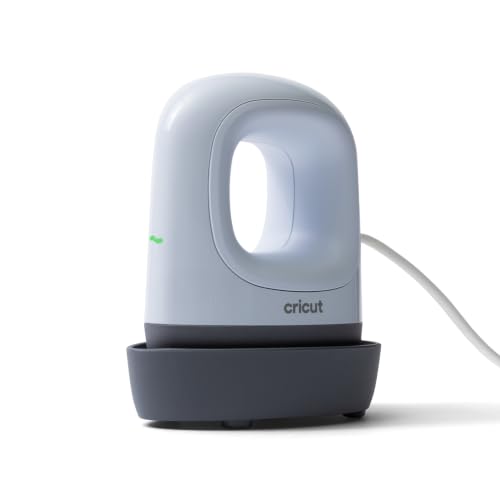
The Cricut EasyPress Mini LT is a detail tool rather than a replacement for a full-size shirt press. Its small ceramic-coated heat plate and precision tip are intended for small or unusually shaped projects where a broad platen would be awkward. A buyer working around seams, pockets, sleeves, hats, or other tight areas can use the tip to place heat more selectively, though the supplied information does not provide the plate dimensions.
The listed maximum temperature is 355°F, or 180°C, and the package includes an insulated safety base. Cricut also identifies a Heat Guide with compatible materials, blanks, time settings, and step-by-step instructions. That combination gives the Mini LT a clear craft-oriented role. It is a poor match for pressing a broad front graphic in one pass, but a sensible companion or standalone tool for small transfers.
Pros
- Uses a ceramic-coated heat plate with a precision tip.
- Reaches a stated maximum temperature of 355°F or 180°C.
- Includes an insulated safety base.
- Provides Heat Guide instructions for listed materials and blanks.
- Is identified for small and personalized heat-transfer projects.
Cons
- The supplied information does not state the heat-plate dimensions.
- The mini format is limited for broad shirt graphics and large flat designs.
Choose the Mini LT for detail work, small designs, and unusual shapes. Buyers needing a primary apparel press should step up to the 12×10 Cricut EasyPress SE or a 15×15 machine, while the Calogy and HTVRONT mini presses offer alternative three-setting controls.
To buy this product, click here.
8. Calogy Mini Heat Press – Best Three-Setting Mini Press

The Calogy Mini Heat Press is unusually specific about its physical size. The machine measures 4.5×2.9×5.1 inches, and its stated heat plate measures 2.87×4.43 inches. That small footprint suits tiny transfers on shirts, hats, bags, masks, socks, pillows, and other areas where a full-size press would be cumbersome. It should be viewed as a focused handheld press, not a broad apparel machine.
A single-button control changes the temperature, unit, and power state, while an LED display shows the real-time temperature information supplied by the product listing. Three settings are listed at 284°F, 320°F, and 356°F. The machine also includes a 15-minute automatic shutoff and a heat-resistant base. The published heating times are seller claims, so they offer context rather than independent proof of warm-up performance.
Pros
- Lists a machine size of 4.5×2.9×5.1 inches.
- Provides a stated 2.87×4.43-inch heat plate.
- Includes three temperature levels from 284°F to 356°F.
- Displays temperature information and supports Fahrenheit/Celsius switching.
- Includes a heat-resistant base and 15-minute automatic shutoff.
Cons
- The 2.87×4.43-inch plate is too small for broad shirt designs in one press.
- The published information identifies three temperature levels rather than a continuously adjustable range.
This is a practical pick for small transfers where exact plate dimensions matter. The Cricut Mini LT offers a precision tip and Heat Guide, while the HTVRONT Mini provides a three-setting alternative with a different control layout.
To buy this product, click here.
9. HTVRONT Mini Heat Press – Best Travel-Style Mini Option
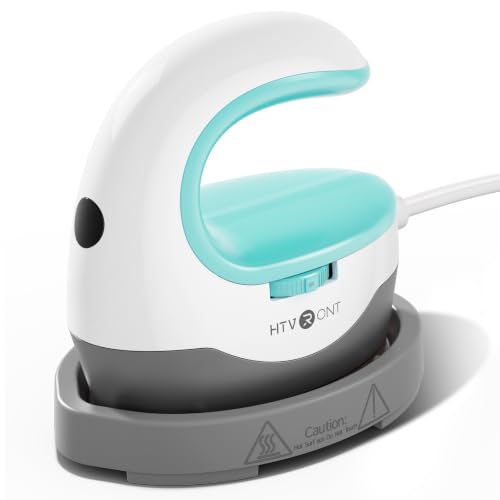
The HTVRONT Mini Heat Press is built around the same narrow use case as other handheld mini presses: small or unusual HTV and sublimation projects. The product information describes it as lightweight and easy to carry, and the package includes an insulated base and user manual. Since no numerical machine weight or plate dimensions are supplied, those claims should be understood as format descriptions rather than a full portability specification.
Three heat settings are listed at 284°F, 320°F, and 356°F, selected with a sliding control. The listing also identifies a handle and says the machine is intended for small projects and travel such as crafting events. That makes it a useful secondary tool for detail work, though a 12×10 or 15×15 press remains better suited to large apparel graphics and wider flat blanks.
Pros
- Lists three heat settings from 284°F to 356°F.
- Includes an insulated base.
- Uses a sliding control for changing heat settings.
- Is identified for small and unusual HTV and sublimation projects.
- Includes a handle and user manual.
Cons
- The supplied information does not state the heat-plate dimensions.
- The mini format is limited for broad designs and large flat pressing areas.
This model makes sense as a small-project press or a second tool for detail work. The Calogy is the better documented choice for buyers who need exact machine and plate measurements, while the Cricut Mini LT adds a stated precision tip and Heat Guide.
To buy this product, click here.
Buying Guide
Match the Pressing Area to Your Projects
A 15×15-inch press provides more stated working area than the 12×10-inch models, which matters for larger shirt graphics and broad flat designs. That does not automatically make it better for every home workspace. A 12×10 press may be easier to position for smaller apparel projects, while a mini plate is suited to a logo, sleeve, pocket, or other tight area.
Choose Manual or Automatic Operation Carefully
Automatic models in this roundup press and release after a timed cycle. That is different from a handheld press or a manual machine such as the Fancierstudio, where the operator controls the pressing movement. Automatic operation can change how the machine is loaded and monitored, but it does not prove faster production, lower labor, or more consistent transfers.
Look at Pressure Information
Adjustable pressure appears on the Fancierstudio, Seeutek, and HTVRONT Auto Heat Press 2. The H10 goes further by displaying pressure information, although the supplied product data does not establish display accuracy. A pressure knob, a pressure display, and an automatic pressure function are different features, so compare the exact mechanism rather than assuming they deliver the same control.
Check Temperature and Timer Controls
Digital controls allow a user to set temperature and time, but a displayed setting is not proof of measured platen accuracy. The Fancierstudio lists a 0 to 699°F range and a 0 to 999-second timer. The Seeutek lists 0 to 482°F and 0 to 999 seconds, while the mini presses use defined temperature levels. Match the control format to the materials and transfer instructions you plan to follow.
Decide Whether Attachments Earn Their Space
The Seeutek is the only selected model with the listed hat, mug, tumbler, plate, mouse pad, and coaster attachments. That can broaden the projects available from one machine, but the attachments also require storage and must match the shapes and sizes of the blanks. If your work is limited to shirts, totes, and other flat items, a single-function press avoids that extra equipment.
Account for Workspace and Electrical Details
The product data gives 110 volts and 1,800 watts for the Fancierstudio, but comparable electrical details are not supplied for every model. Do not infer circuit requirements from a product’s size or brand. Also remember that platen dimensions are not the same as the full machine footprint. Check the manufacturer’s current installation information and leave room for loading, opening, and handling the press.
Use Process Instructions for the Specific Transfer
Temperature, time, and pressure depend on the transfer, substrate, coating, and manufacturer instructions. A machine being listed for HTV, sublimation, or DTF does not guarantee the same result with every material in that category. Start with the instructions for the transfer and blank you are using, then make small adjustments only when the process guidance supports them.
Best Heat Press for Home Use FAQ
What is the best heat press for general home use?
The HTVRONT Auto Heat Press Machine 15×15 is the strongest general pick in this selection because it combines a stated 15×15-inch pressing area with automatic pressing, automatic release, multiple modes, and a drawer-style board. Buyers focused on drinkware and caps may prefer the Seeutek because its listed package includes specialty attachments.
Is a 15×15 heat press better than a 12×10 model?
A 15×15 model provides a larger stated pressing area, which can be useful for larger flat designs. A 12×10 model may suit buyers whose projects fit that area or who prefer the format of a handheld press. Size alone does not establish better heating, pressure, durability, or transfer quality.
Are mini heat presses suitable for shirts?
Mini presses can handle small designs and tight areas on shirts, but their smaller plates require more repositioning for broad graphics. The Calogy lists a 2.87×4.43-inch plate, while the Cricut EasyPress Mini LT and HTVRONT Mini are described for small or unusual projects. A 12×10 or 15×15 press is a more suitable primary machine for large shirt designs.
Can these home heat presses work with sublimation?
Several listings identify sublimation support, including the HTVRONT flat presses, Seeutek, Cricut EasyPress SE, and HTVRONT Mini. That listing language does not guarantee compatibility with every sublimation blank or process. Follow the instructions for the specific transfer and substrate, including its temperature, time, pressure, and coating requirements.
Does automatic release make a press fully automatic?
No. The HTVRONT automatic models are described as pressing after the user sets the parameters and releasing after the timed cycle. That identifies specific automatic functions. It does not establish that loading, material positioning, transfer preparation, or every other part of the process is automatic.
Is a multifunction heat press worthwhile for home use?
It can be worthwhile if your projects include the listed mugs, tumblers, plates, caps, mouse pads, or coasters. The Seeutek includes those attachment categories and a 15×15 flat press. If you mainly press shirts and totes, a single-function machine may be a more direct match for the work you actually plan to do.
What should beginners check before buying a home heat press?
Start with the pressing area, control type, pressure mechanism, opening style, included attachments, temperature range, timer, and electrical information. Also check whether the machine is a complete primary press or a mini detail tool. A low price or compact shape does not by itself establish that a machine will suit your projects.
Can a flat heat press replace a hat or mug press?
Do not assume that it can. The Seeutek listing specifically includes hat, mug, tumbler, and plate attachments. The flat HTVRONT, Fancierstudio, and Cricut models are presented primarily as flat presses, and the supplied information does not establish dedicated curved drinkware or cap capability for them.
Final Verdict
The HTVRONT Auto Heat Press Machine 15×15 is the strongest overall home-use recommendation because its stated 15×15-inch area serves common flat projects while its automatic mode presses and releases after the timed cycle. Its multiple modes, drawer-style board, listed support for several flat materials, and 15-minute auto-off give it a broader home role than a mini press or a basic handheld model. The recommendation is based on those supplied characteristics, not on an assumption about production speed or transfer quality.
The Seeutek is the meaningful alternative for households that want listed hat, mug, tumbler, plate, mouse pad, and coaster attachments alongside a 15×15 flat press. The Fancierstudio suits buyers who prefer manual operation with adjustable pressure and electronic controls. For smaller projects, the Cricut EasyPress Mini LT, Calogy, and HTVRONT Mini each have a more focused role, while the H10 and Cricut EasyPress SE occupy the middle ground with 12×10-inch formats. Match the machine to the blanks, design sizes, controls, and workspace you will actually use.
