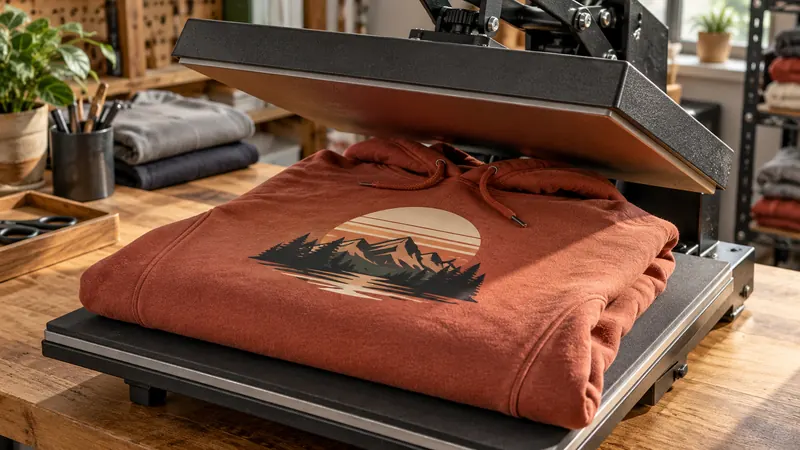
A T-shirt and hoodie press has to cover enough fabric for the design, apply controllable pressure across the transfer area, and give you a workable way to position garments around seams, pockets, and thicker sections. A small craft press may handle a sleeve or a compact logo, while a 15×15 machine gives much more room for front and back apparel designs. The machine format changes the workflow before the first transfer is even placed.
The common mistake is judging a press by a single number or marketing label. A larger platen does not prove better heating, a pressure display does not prove pressure accuracy, and automatic operation does not establish higher output. For T-shirts and hoodies, the useful details are the stated pressing area, garment-loading design, pressure mechanism, temperature and timer controls, and whether the machine can accommodate the type of transfer work you plan to do.
Different buyers will reach different conclusions. The HTVRONT 15×15 Auto Heat Press is the strongest overall fit here because it combines a full apparel-sized platen with automatic pressing and release, while the Delclynee offers a manually controlled slide-out layout. The HTVRONT 12×10 is a smaller flat-press alternative, and the Calogy Mini is better treated as a detail tool for small designs rather than a replacement for a full-size shirt press.
Quick Answer
- Best Overall: HTVRONT Auto Heat Press Machine 15×15 for automatic pressing and release across a stated 15×15-inch area.
- Best Slide-Out Option: Delclynee 15×15 Slide-Out Heat Press for a pull-out lower platen, adjustable pressure knob, and threadable garment workspace.
- Best Smaller Flat Press: HTVRONT H10 12×10 Heat Press for a smaller footprint of pressing area with a pressure display and dual handles.
Best Heat Press for T-Shirts and Hoodies Comparison Table
| Product | Best For | Press Type | Pressing Area | Workflow Feature |
|---|---|---|---|---|
| HTVRONT Auto Heat Press Machine | Automatic apparel pressing | Automatic slide-out design | 15×15 inches | Auto-adjusts thickness up to 1 inch and auto-releases |
| Delclynee Slide-Out Heat Press | Garment loading away from the heat source | Clamshell with pull-out lower platen | 15×15 inches | Lower platen extends 12.25 inches |
| HTVRONT H10 Heat Press | Smaller shirt and hoodie designs | Manual flat press | 12×10 inches | Pressure, time, and temperature display |
| Calogy Mini Heat Press | Small logos and detail areas | Handheld mini press | 2.87×4.43-inch heat plate | Three temperature levels and safety base |
The detailed reviews below show how each machine’s pressing area, controls, and garment-loading design affect T-shirt and hoodie work.
1. HTVRONT Auto Heat Press Machine 15×15 — Best Overall

The HTVRONT Auto Heat Press is the clearest match for buyers pressing full-size T-shirt and hoodie designs. Its stated 15×15-inch working area gives a broad square surface for front graphics, while the slide-out ironing board changes the loading sequence. Instead of reaching beneath a fixed hot platen, the garment can be positioned on the board before it is pushed into the machine.
Its automation is specific rather than vague. After the board is pushed in and the start control is pressed, the listing says the machine presses automatically, adjusts to project thickness up to 1 inch, and releases when the timer ends. Four fast modes, two custom modes, and an automatic mode are listed. The product information also identifies a 15-minute inactivity shutoff and compatibility with apparel, totes, wood signs, and ceramic coasters up to 1 inch thick, although the published details do not establish performance on every fabric or transfer type.
Pros
- Provides a stated 15×15-inch pressing area for T-shirts and hoodies.
- Automatically presses and releases after the timed cycle.
- Automatically adjusts to listed project thicknesses up to 1 inch.
- Includes four fast modes, two custom modes, and an automatic mode.
- Uses a slide-out board and lists a 15-minute inactivity shutoff.
Cons
- The published information does not identify a temperature-accuracy tolerance or measured platen uniformity.
- The stated 15×15-inch area is smaller than a larger-format press would be for oversized graphics.
This is the best fit for someone who wants a primary flat press with an automatic cycle and enough stated area for common shirt and hoodie designs. Buyers who prefer to control every opening and closing movement manually, or who need a larger-than-15×15 pressing surface, may prefer another format. Its main trade-off is the automatic mechanism, which simplifies the pressing sequence but gives less manual control than the Delclynee.
To buy this product, click here.
2. Delclynee 15×15 Slide-Out Heat Press — Best Slide-Out Option

The Delclynee takes a more manual approach while keeping the 15×15-inch platen size that suits many T-shirt and hoodie graphics. Its pull-out lower platen extends up to 12.25 inches, creating a defined loading surface away from the upper heat platen. That layout is especially relevant for garments that need to be threaded over the lower platen, since the supplied information specifically identifies clearance for pressing a single fabric layer.
Controls are clearly stated. The machine uses a 110V supply, lists 1250W power, provides a temperature range of 32 to 455°F, and offers a timer range of 0 to 999 seconds. An adjustable pressure knob gives the operator a physical pressure control, while the floating upper platen is described as self-adjusting across uneven surfaces or thicker substrates. The product information also mentions a fitted lower-pad cover and five audible beeps when the target temperature is reached or the timer finishes.
Pros
- Provides a stated 15×15-inch heat platen.
- Uses a pull-out lower platen with up to 12.25 inches of extension.
- Includes an adjustable pressure knob.
- Lists a 32 to 455°F temperature range and 0 to 999-second timer range.
- Provides garment-threading clearance and a fitted lower-pad cover.
Cons
- The machine uses a manual clamshell format rather than the HTVRONT Auto Press’s automatic cycle.
- The published information does not state the machine’s overall dimensions or weight.
The Delclynee suits buyers who want a full 15×15-inch press with a pull-out loading arrangement and manual pressure adjustment. It may fit better than the automatic HTVRONT for users who want direct control over the press cycle, while the HTVRONT remains the more automation-focused option. The important distinction is the mechanism, not a claim that one produces better transfers than the other.
To buy this product, click here.
3. HTVRONT H10 12×10 Heat Press — Best Smaller Flat Press

The HTVRONT H10 sits between a full 15×15 apparel press and a handheld detail tool. Its stated 12×10-inch heat plate provides a rectangular work area for smaller shirt graphics, hoodie logos, pillows, bags, and home décor projects. That size can be useful for buyers whose designs do not need a full 15-inch square, though it leaves less stated area for broad front graphics than the two 15×15 models above.
A built-in pressure sensor displays pressure data alongside time and temperature. The listing also identifies dual handles, an audible completion signal, an insulated safety base, and automatic shutoff after 15 minutes of inactivity. The seller describes its aluminum heat plate and ceramic coating as supporting rapid, even heating, but those published claims are not independent measurements of temperature uniformity. The press is listed for HTV, sublimation, and heat-transfer projects, yet transfer-specific settings still need to follow the media and garment instructions.
Pros
- Provides a stated 12×10-inch pressing area.
- Displays pressure, time, and temperature on the digital screen.
- Includes a built-in pressure sensor.
- Uses dual handles and an audible signal at the end of pressing.
- Lists a 15-minute inactivity shutoff and insulated safety base.
Cons
- Its 12×10-inch area is smaller than the 15×15-inch areas of the top two selections.
- The published information does not provide a temperature-accuracy tolerance or a stated maximum garment thickness.
This model makes sense for T-shirts and hoodies with modest-sized designs, especially when a pressure readout is more useful to the buyer than automatic release. Larger front graphics may require repositioning or a larger press. It is also a more suitable primary machine than the Calogy Mini for apparel work, while the HTVRONT Auto Press remains the stronger fit for buyers who specifically want an automated pressing cycle.
To buy this product, click here.
4. Calogy Mini Heat Press — Best for Small Details

The Calogy Mini is a handheld detail press, not a full-size substitute for the larger machines in this guide. Its stated heat plate measures 2.87×4.43 inches, which suits small logos, narrow sections, sleeves, pockets, and other areas where a broad platen would be awkward. The supplied applications include T-shirts, hats, caps, pillows, bags, masks, socks, and clothing, but the small plate limits how much of a large hoodie graphic can be covered in one pass.
Operation centers on one button. The product information lists three temperature levels, 284°F, 320°F, and 356°F, plus a switchable Celsius and Fahrenheit display. It also identifies a stated size of 4.5×2.9×5.1 inches, a heat-resistant base, and automatic power-off after 15 minutes of inactivity. The listing gives approximate heating times for its three temperature levels, though those are published product claims rather than Heat Press HQ measurements.
Pros
- Provides a stated 2.87×4.43-inch heat plate for small designs.
- Lists three temperature levels from 284°F to 356°F.
- Uses a switchable Celsius and Fahrenheit display.
- Includes a heat-resistant safety base.
- Lists automatic power-off after 15 minutes of inactivity.
Cons
- The small heat plate is unsuitable for covering most large T-shirt or hoodie graphics in one press.
- It provides three preset temperature levels rather than the broader temperature control listed for the Delclynee.
The Calogy is worth considering as a secondary tool for small apparel details or unusual shapes. A buyer seeking one primary machine for T-shirts and hoodies should move up to a 12×10 or 15×15 flat press, since the mini plate would require multiple placements for a larger design. Its trade-off is straightforward: more maneuverable coverage for small areas, far less coverage for full apparel graphics.
To buy this product, click here.
Buying Guide
Start With the Design Area
Platen size is the first practical filter for shirts and hoodies. The two 15×15 machines provide the largest stated flat pressing area in this selection, while the HTVRONT H10 measures 12×10 inches. The Calogy’s 2.87×4.43-inch plate belongs in a different category for small details. A nominal platen measurement describes the stated pressing surface, not the complete machine footprint or a guarantee that every large design can be transferred in one cycle.
Choose the Loading Mechanism
The HTVRONT Auto Press uses a slide-out board, and the Delclynee identifies a pull-out lower platen that extends 12.25 inches. Both designs change how a garment is positioned before pressing. The Delclynee is specifically described as threadable, which matters for placing a shirt over the lower platen so pressure is concentrated on a single fabric layer. The H10 and Calogy use different formats, so compare the physical loading method with the garments you plan to decorate.
Separate Automatic Functions From Manual Control
The HTVRONT Auto Press is described as automatically pressing, adjusting to listed thicknesses up to 1 inch, and releasing after the timer ends. That is different from a machine that simply has an automatic shutoff. The Delclynee provides a manual pressure knob, while the H10 displays pressure data through a built-in sensor. None of these features alone proves transfer consistency or higher output, so choose the control style that matches the way you want to operate the press.
Check Temperature and Timer Information
The Delclynee lists a 32 to 455°F temperature range and a 0 to 999-second timer range. The Calogy lists three preset temperature levels, and the H10 provides time and temperature information on its digital screen. A display shows the selected setting, not independently measured platen accuracy. Transfer instructions can vary by vinyl, DTF transfer, sublimation material, garment composition, and transfer supplier, so the press controls are only one part of the process.
Think About Hoodie Construction
Hoodies introduce seams, collars, pockets, drawstrings, and thicker sections that can affect garment positioning. The Delclynee’s stated threadable clearance and the HTVRONT Auto Press’s listed ability to adjust to project thickness up to 1 inch are relevant published details. They do not establish universal compatibility with every hoodie or maximum safe thickness for every material. Check the garment and transfer instructions before pressing across raised or uneven areas.
Account for Workspace and Electrical Details
The Delclynee listing specifies 110V and 1250W. The other supplied product information does not provide a complete set of electrical and machine-footprint details for comparison. Do not infer outlet requirements, circuit suitability, overall dimensions, or weight from platen size alone. Leave room for garment loading and for the movement of a slide-out board, and keep a hot press positioned according to its supplied safety instructions.
Best Heat Press for T-Shirts and Hoodies FAQ
What Is the Best Overall Heat Press for T-Shirts and Hoodies?
The HTVRONT Auto Heat Press Machine is the strongest overall match in this selection because it combines a stated 15×15-inch pressing area with automatic pressing, thickness adjustment up to 1 inch, and automatic release after the timed cycle. Its published information does not establish universal transfer performance, so media-specific instructions still matter.
Is a 15×15 Heat Press Better for Hoodies Than a 12×10 Model?
A 15×15 press provides more stated pressing area than a 12×10 press, which can reduce the need to reposition a larger design. That does not automatically make it better in every respect. Workspace, loading mechanism, control style, and the actual size of your graphics also affect the choice.
Can the Calogy Mini Press Handle a Full Hoodie Design?
The Calogy Mini has a stated 2.87×4.43-inch heat plate, so it is better suited to small logos, narrow sections, and detail areas. A large hoodie graphic would require multiple placements, and the supplied information does not establish a full-design workflow for that press.
What Does a Slide-Out Lower Platen Change?
A slide-out lower platen lets the operator pull the garment-loading surface away from the upper heat platen before positioning the item. The Delclynee listing identifies a 12.25-inch extension and threadable clearance. This describes the loading arrangement, not a guarantee of better transfer results.
Does Automatic Release Mean a Press Is Fully Automatic?
No. The HTVRONT Auto Press is described as automatically pressing, adjusting to listed thicknesses, and releasing after the timed cycle. Automatic release is one defined function. It does not prove that every setup step, pressure decision, transfer placement, or garment adjustment is automated.
Does a Pressure Display Prove Accurate Pressure?
No. The HTVRONT H10 lists a built-in pressure sensor and a display for pressure, time, and temperature. That identifies the monitoring feature, but the supplied information does not provide a pressure-accuracy tolerance or independent verification of the displayed value.
Can These Presses Be Used for Both HTV and Sublimation?
The supplied listings identify HTV, sublimation, or heat-transfer applications for some of the machines. That does not mean every transfer, blank, fabric, or setting is interchangeable. Follow the instructions for the specific transfer and substrate, including its temperature, time, pressure, and handling requirements.
Should I Buy a Full-Size Press or a Mini Press?
Choose a full-size press if your main work involves front or back T-shirt and hoodie graphics. A mini press is more appropriate for small logos, sleeves, pockets, and detail areas. The Calogy can complement a larger press, but its stated plate size makes it a limited primary machine for broad apparel designs.
Final Verdict
The HTVRONT Auto Heat Press Machine 15×15 is the strongest overall selection for T-shirts and hoodies because its stated pressing area fits common apparel work and its automatic cycle includes pressing, thickness adjustment up to 1 inch, and release after the timer. The slide-out board also gives the garment a defined loading surface. Those are concrete workflow distinctions, while claims about heat uniformity or transfer quality remain outside the supplied evidence.
The Delclynee is the key alternative for a manually controlled 15×15 press with a pull-out lower platen, adjustable pressure knob, and listed temperature and timer ranges. The HTVRONT H10 suits smaller designs and buyers who want a pressure display across a 12×10-inch area. The Calogy Mini belongs with small-detail tools, not full hoodie graphics. Match the machine to the actual design dimensions, garment construction, loading method, and transfer instructions rather than choosing by a single feature.
