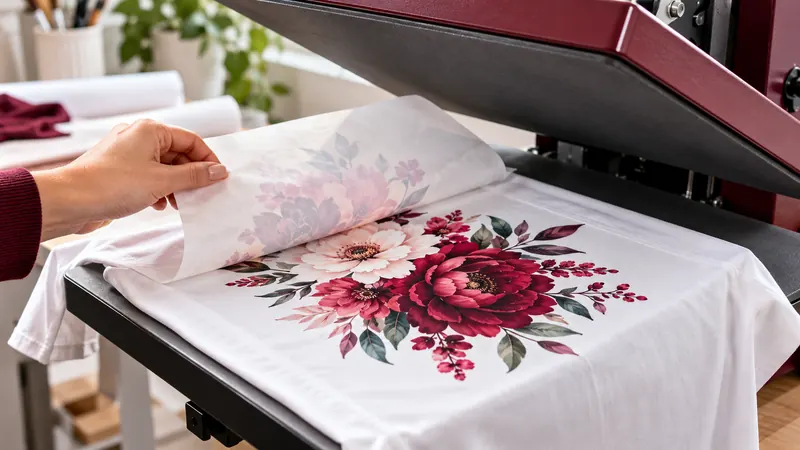
Do I Need a Heat Press for sublimation? Usually, yes, if you plan to sublimate flat garments, signs, panels, or other flat blanks with consistent results. A heat press supplies controlled heat, pressure, and contact across the transfer area. Those conditions allow sublimation ink to change into gas and bond with a compatible polyester surface or polymer coating.
A heat press is not the only equipment that can apply sublimation. A suitable mug press, tumbler press, convection oven, or calendar press may be appropriate for specific blanks. The equipment must match the shape of the item and the instructions for the sublimation system. A household iron generally does not provide the even temperature, stable pressure, or consistent contact that sublimation requires.
Why a Heat Press Is Commonly Used for Sublimation
Sublimation transfers dye into a compatible surface rather than placing an opaque layer on top of the material. The process depends on a combination of temperature, time, pressure, transfer paper, ink, and substrate.
A flat heat press is useful because it can:
- Hold the transfer and blank together during the cycle.
- Apply pressure across the design area.
- Maintain a set temperature for a defined period.
- Accommodate flat garments and rigid blanks with suitable coatings.
- Support repeatable placement for multiple projects.
The controller’s displayed temperature is a setpoint. It does not prove that every part of the platen reaches exactly that temperature. Press condition, platen size, contact, and heat distribution can affect the result.
What You Need Besides the Heat Press
A heat press alone cannot produce a sublimated design. A typical flat sublimation setup includes:
- A sublimation printer using compatible sublimation ink.
- Sublimation transfer paper.
- A digital design and suitable color-management workflow.
- A compatible polyester garment or polymer-coated blank.
- Heat-resistant tape or another approved method for holding the transfer in place.
- Protective paper or another material specified by the transfer and blank instructions.
- Heat-resistant handling equipment appropriate for hot blanks.
Ordinary inkjet ink and standard printer paper do not create a sublimation system. A heat press also cannot turn cotton, untreated wood, ordinary ceramic, or an uncoated metal sheet into a sublimation-ready surface. The blank must have the required polyester content or a suitable polymer coating.
Can You Sublimate Without a Traditional Heat Press?
Sometimes. The appropriate alternative depends on the shape and construction of the blank.
| Blank or project | Possible equipment | Important limitation |
|---|---|---|
| Flat polyester apparel | Flat heat press | The garment must be compatible, and seams or pockets can interfere with contact. |
| Flat coated panels | Flat heat press | The panel needs a sublimation-compatible coating and suitable heat tolerance. |
| Mugs | Mug press or suitable mug-heating system | The diameter, shape, and coating must match the equipment. |
| Tumblers | Tumbler press, oven system, or another approved method | The blank and heating method must support the tumbler’s size and shape. |
| Large-format fabric | Calendar press or industrial transfer equipment | Equipment requirements vary with the material width and production process. |
A household iron is a poor substitute for most sublimation work. It can have uneven heat, limited working area, and inconsistent pressure. Those limitations make it difficult to maintain the conditions needed for a clean, durable transfer.
What Type of Heat Press Works for Sublimation?
A flat press with a suitable platen can handle many apparel and flat-blank applications. Clamshell, swing-away, and slide-out designs may all be used if the machine can accommodate the blank and follow the relevant process instructions.
The press style does not determine whether sublimation will work by itself. Check the practical details that affect the project:
- Platen area: The nominal dimensions should cover the artwork and allow practical placement. A transfer that matches the stated platen size may still be difficult to position around seams, collars, edges, or other raised features.
- Flat contact: The transfer and blank need appropriate contact during the cycle. A pocket, zipper, button, or thick seam can create an uneven surface.
- Temperature control: The press should provide a controllable setpoint suitable for the exact sublimation process.
- Timer function: A timer helps repeat the specified cycle, but it does not verify that the transfer received the intended surface temperature.
- Electrical requirements: Follow the exact machine documentation for voltage, amperage, plug type, and circuit requirements. Do not assume these details from wattage alone.
A mini press may be useful for small areas, but its smaller platen can make it difficult to cover a larger design in one cycle. Multiple pressing positions can produce inconsistent results if the process does not support them. A large platen provides more nominal working area, but it does not automatically establish better temperature accuracy or heat distribution.
Temperature, Time, and Pressure Are Product-Specific
Sublimation does not have one universal temperature and time combination for every printer, paper, blank, and heat press. The exact instructions should come from the blank manufacturer, transfer-material supplier, or sublimation system documentation.
Follow the specified combination of:
- Set temperature.
- Pressing time.
- Pressure level or pressure description.
- Transfer orientation.
- Protective paper requirements.
- Cooling or handling instructions.
Do not treat a pressure knob position as a universal PSI measurement. A machine’s pressure terminology can vary, and a displayed pressure value does not automatically prove calibrated or evenly distributed pressure.
Increasing heat, time, or pressure without guidance can create new problems. Excess heat may affect the fabric, coating, paper, or dye behavior. Excess pressure can leave impressions or affect an uneven blank. A longer cycle may alter color or damage a heat-sensitive surface.
Basic Flat Sublimation Workflow
The exact procedure should follow the instructions for the transfer paper, ink system, blank, and press. A general workflow looks like this:
- Confirm blank compatibility. Verify that the garment contains suitable polyester or that the rigid item has a sublimation-ready coating.
- Prepare the artwork and print the transfer. Use the paper and printer settings specified for the sublimation system. Mirror the design when the process instructions require it.
- Prepare the blank. Remove lint and position the item so seams, pockets, zippers, or other raised features do not interfere with the pressing area.
- Set up the press. Use the temperature, time, pressure, and protective materials specified for the exact blank and transfer system.
- Position and secure the transfer. Place the printed side against the compatible surface and use an approved method to prevent movement during closing.
- Press the project. Apply the documented cycle. Avoid opening the press repeatedly or changing settings during the cycle without a process-based reason.
- Remove and inspect the transfer. Follow the supplier’s handling instructions. Look for signs of movement, uneven contact, moisture-related defects, or incomplete color development.
Use fresh protective paper when the process requires it. Sublimation dye can transfer to the platen or later projects if contaminated paper or other protective materials are reused.
Why a Sublimation Result May Look Faded
A faded result does not automatically mean the heat press needs a higher temperature. Check the process in a logical order:
- Confirm that the blank is compatible and has the expected polyester content or coating.
- Verify that the transfer was printed with sublimation ink on suitable paper.
- Check the blank manufacturer’s instructions for the required cycle.
- Confirm that the transfer did not move during pressing.
- Check for moisture in the garment or transfer materials where the process documentation identifies moisture as a risk.
- Look for incomplete contact caused by seams, pockets, uneven surfaces, or an unsuitable platen arrangement.
- Verify the press’s displayed setpoint and, if results remain inconsistent, test the platen with an appropriate measurement method.
One temperature reading at the center of a platen does not prove that the entire surface heats uniformly. A meaningful heat-distribution check requires multiple locations, a consistent measurement method, and an understanding of the tool’s limitations. Testing the press is different from calibrating it. Any adjustment procedure must come from the exact machine manual or manufacturer support.
Do You Need a Heat Press for Sublimation on Shirts?
For sublimation shirts, a flat heat press is generally the practical choice. The shirt should have a compatible polyester construction, and white or light-colored fabric is commonly used because sublimation dye does not behave like an opaque ink layer. The fabric color and polyester content can affect the visible result.
Construction also matters. A design placed across a pocket, thick seam, collar, zipper, or button may not receive the same contact as a design on a flat section of fabric. Position the garment so the artwork rests on an appropriate pressing surface, and follow the garment and transfer instructions.
When a Heat Press Is the Wrong Equipment
A flat heat press may be unsuitable when the blank requires curved, cylindrical, or specialty contact. Mugs and tumblers generally need equipment that matches their circumference and heating method. A flat platen does not automatically provide even contact around a curved object.
The same principle applies to caps, shaped panels, and unusual blanks. Heat tolerance alone does not prove sublimation compatibility. Verify the coating, dimensions, shape, and equipment requirements before pressing.
Bottom Line
You need a suitable heat-application system for sublimation, and a flat heat press is the standard practical option for many flat garments and coated blanks. It is not the only possible equipment, but a household iron is generally unsuitable for dependable sublimation. The most important requirements are a compatible sublimation blank, the correct ink and paper system, suitable contact, and the exact temperature, time, and pressure instructions for that project.
