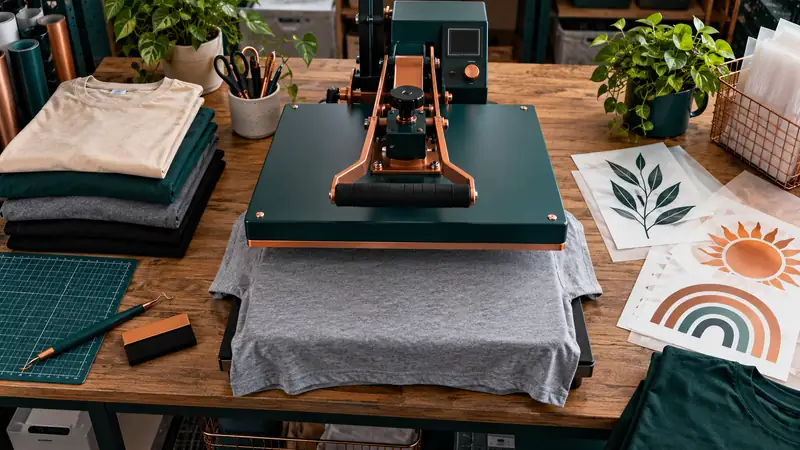
A small business usually needs one press to cover its core work without turning the workbench into a maze of single-purpose equipment. Shirts, hoodies, totes, transfers, and occasional promotional pieces can call for different pressing areas and operating styles, so the best heat press for small business is rarely the machine with the longest feature list. A 15×15 platen, adjustable pressure, a clear timer, and a mechanism that suits the operator’s available space often matter more than marketing language.
The common mistake is buying for a hypothetical product catalog instead of the work actually being sold. A mini press can handle small details, but it is a poor primary machine for broad shirt graphics. A multifunction unit may cover mugs, caps, and plates, yet its flat platen is smaller than some apparel-focused choices. Electrical requirements, pressing area, manual versus automatic operation, and whether the published specifications clearly identify the supported applications should shape the decision. The HTVRONT Auto Heat Press 2 leads this group because it combines a 15×15 working area with adjustable pressure, automatic pressing and release, and stated clearance for thicker items.
Different small businesses will prioritize different trade-offs. An apparel seller may prefer an automatic 15×15 press, a mixed gift shop may value a multifunction attachment set, and a compact studio may need a smaller manual machine. The selections below keep those differences visible rather than treating every heat press as interchangeable.
Quick Answer
- Best Overall: HTVRONT Auto Heat Press 2 for a 15×15 work area, adjustable pressure, automatic pressing, and automatic release.
- Best for Mixed Products: Whubefy Upgrade Heat Press for its 15×12 flat platen plus mug, cap, and plate attachments.
- Best Manual Option: Fancierstudio Digital Heat Press 15 x 15 for adjustable pressure and broad stated time and temperature controls.
- Best Compact Business Press: HTVRONT 12×10 Heat Press with Pressure Display for a smaller footprint and displayed pressure, time, and temperature.
Best Heat Press for Small Business Comparison Table
| Product | Best For | Press Type | Pressing Area | Automation | Supported Applications |
|---|---|---|---|---|---|
| HTVRONT Auto Heat Press 2 | Apparel businesses needing adjustable pressure | Automatic flat press | 15×15 | Automatic pressing and release | Apparel, DTF projects, thicker items |
| Stahls’ Hotronix Auto Clam | Businesses seeking a 16×16 auto-clam format | Auto-clam | 16×16 | Auto-clam operation | Garments and accessories, as stated |
| HTVRONT Auto Heat Press 15×15 | Hands-free apparel pressing | Automatic flat press | 15×15 | Automatic pressure adjustment and release | T-shirts, totes, apparel, wood signs, ceramic coasters |
| Whubefy Upgrade Heat Press | Mixed apparel and gift products | 360-degree swing-away multifunction press | 15×12 | Digital controls | Shirts, mugs, caps, plates, tiles, mouse pads, puzzles |
| HTVRONT 12×10 Heat Press with Pressure Display | Smaller apparel workspaces | Manual flat press | 12×10 | Auto shutoff | HTV, sublimation, heat-transfer projects |
| Slendor 12×15 5-in-1 | Businesses adding mugs, caps, and plates | 360-degree swing-away multifunction press | 12×15 | Digital timer and temperature controls | Shirts, caps, mugs, plates, tiles, coasters, mouse pads |
| VEVOR 12×15 5-in-1 | Multifunction pressing with stated protections | 360-degree swing-away multifunction press | 12×15 | Digital timer and temperature controls | Shirts, hoodies, mugs, caps, plates, ceramics, glass |
| HTVRONT 15×15 Auto Heat Press | Preset modes and automatic release | Automatic flat press with slide-out platen | 15×15 | Automatic pressing and release | T-shirts, totes, apparel, wood signs, ceramic coasters |
| Fancierstudio Digital Heat Press 15 x 15 | Manual apparel pressing | Manual flat press | 15×15 | Manual operation | T-shirts, sublimation, rhinestone projects, heat transfers |
The detailed reviews explain how each machine’s size, mechanism, controls, and attachments fit different small-business setups.
1. HTVRONT Auto Heat Press 2 — Best Overall

The HTVRONT Auto Heat Press 2 has the clearest feature match for a small apparel business that wants a primary flat press with less manual handling. Its stated 15×15 pressing area fits common shirt-sized work, while the pressure system can be adjusted up to the published 80 kg (170 lb) figure. That makes pressure adjustment a defined part of the machine rather than an unspecified assumption. The product information also identifies clearance for items up to 4.5 cm (1.77 inches), which gives buyers a concrete reference for deciding whether their hoodies or thicker blanks fit the intended setup.
Its automatic sequence is specific: after the settings are entered, the machine presses after the R button is used, signals when the timed cycle ends, and releases the material automatically. The screen angle can be adjusted through seven positions from 0 to 75 degrees, and the unit shuts off after 15 minutes without operation. The listing states that it reaches 410°F in 5 minutes and 30 seconds, though that remains a published claim rather than an independent measurement. For a shirt-focused shop, the combination of 15×15 coverage, adjustable pressure, and automated release is more relevant than a bundle of specialty attachments.
Pros
- Provides a stated 15×15 pressing area.
- Offers adjustable pressure up to the published 80 kg (170 lb) figure.
- Automatically presses and releases after the timed cycle.
- Lists clearance for items up to 4.5 cm (1.77 inches).
- Includes an adjustable-angle screen and 15-minute auto shutoff.
Cons
- The published information does not identify a machine footprint or weight.
- It is a flat apparel press, so the supplied information does not identify mug, cap, or plate attachments.
This is the strongest fit for a business centered on apparel, DTF projects, and thicker shirt-related items that can use its stated clearance. A multifunction press may fit better for a gift business that sells drinkware and plates, while a manual 15×15 model may suit buyers who prefer direct control over every cycle.
To buy this product, click here.
2. Stahls’ Hotronix Auto Clam Heat Press — Best Auto-Clam Option

The Stahls’ Hotronix Auto Clam brings a larger stated 16×16 pressing area and an auto-clam format to the shortlist. That extra inch in each direction gives the operator more stated working area than a 15×15 press, which may matter for larger front graphics or businesses that frequently handle broader layouts. The supplied information identifies a 110V electrical specification, but it does not provide wattage, temperature range, timer range, or a detailed pressure mechanism, so those points should be confirmed before purchase.
The listing positions this machine for garments and accessories and describes it as suitable for repeated use, but those descriptions are seller claims rather than independent testing. Its meaningful distinction here is the combination of a 16×16 platen and auto-clam architecture. A buyer who prefers that operating format can separate it from the automatic slide-out HTVRONT machines, which use a different mechanism. The supplied information does not establish automatic release, programmable modes, or specific clearance for thick items, so the machine should be assessed around its stated size and auto-clam design.
Pros
- Provides a stated 16×16 pressing area.
- Uses an identified auto-clam format.
- Lists a 110V electrical specification.
- Is described for garments and accessories.
- Offers a larger stated pressing area than the 15×15 flat presses in this guide.
Cons
- The supplied information does not clearly state the temperature range or timer range.
- The published details do not identify a pressure adjustment method or maximum item thickness.
This model suits a business that values the 16×16 area and specifically wants an auto-clam press. Buyers who need documented automatic release, pressure figures, or thick-item clearance have more concrete information available from the HTVRONT Auto Heat Press 2.
To buy this product, click here.
3. HTVRONT Auto Heat Press 15×15 — Best for Preset Workflows

This HTVRONT model uses a 15×15 format and a slide-out ironing board, giving the operator a distinct loading arrangement from a fixed lower platen. The listing states that the machine can automatically adjust to project thickness up to 1 inch, press after the board is pushed in and the R button is selected, then release when the timer ends. It also identifies four fast modes, two custom modes, and an automatic mode, which may appeal to a business that repeats several known press settings across its catalog.
The published information lists applications including T-shirts, totes, apparel, wood signs, and ceramic coasters up to 1 inch thick. It also states that the machine reaches 320°F in about four minutes and 410°F in a shorter time than other auto presses, but these are listing claims and not Heat Press HQ measurements. The 15-minute auto-off feature and separated ironing board are concrete workflow details. They do not remove the need to supervise a hot machine, yet they give the buyer specific operating features to compare with manual presses.
Pros
- Provides a stated 15×15 pressing area.
- Uses a slide-out ironing board for loading.
- Lists automatic thickness adjustment up to 1 inch.
- Includes four fast modes, two custom modes, and an automatic mode.
- States compatibility with apparel, wood signs, and ceramic coasters up to 1 inch.
Cons
- The published information does not provide a numeric pressure range.
- The stated heat-up figures are seller claims and are not independent measurements.
This is a useful fit for an apparel business that wants automatic release and repeatable preset access without moving to a multifunction attachment system. The newer HTVRONT Auto Heat Press 2 provides more explicit pressure and clearance figures, while this model offers a clearly described set of operating modes.
To buy this product, click here.
4. Whubefy Upgrade Heat Press — Best With Attachments

The Whubefy is aimed at a mixed-product business rather than a shirt-only operation. Its stated 15×12 flat platen is paired with four mug attachments for 9 oz, 11 oz, 12 oz, and 17 oz vessels, plus cap and plate accessories. The published package also identifies a 110V, 900W electrical specification, a timer range of 0 to 999 seconds, and a temperature range of 32°F to 450°F. Those details make the product range easier to map against a business selling apparel alongside mugs, caps, and plates.
The press uses a 360-degree swing-away arm, and the listing describes a controller that switches between Fahrenheit and Celsius. It also mentions an automatic overload circuit protector and insulated exterior construction. Those are specific supplied features, not a guarantee that the machine can be left unattended. The flat area is 15×12 rather than 15×15, so a business focused on broad shirt graphics gives up some listed width while gaining the included specialty attachments.
Pros
- Includes a stated 15×12 flat platen.
- Lists four mug attachments covering 9 oz, 11 oz, 12 oz, and 17 oz vessels.
- Includes cap and plate accessories.
- Uses a 360-degree swing-away arm.
- Provides stated 110V, 900W, 32°F to 450°F, and 0 to 999-second specifications.
Cons
- The flat pressing area is narrower than the 15×15 and 16×16 options in this guide.
- The supplied information does not identify the exact cap or plate dimensions.
This machine makes sense for a product catalog that genuinely includes several supported item types. A shirt-focused business may get more useful working area from a 15×15 or 16×16 flat press, while a mixed catalog can make practical use of the listed mug, cap, and plate attachments.
To buy this product, click here.
5. HTVRONT Heat Press 12×10 with Pressure Display — Best Compact Business Press

The 12×10 HTVRONT gives a small business a defined middle ground between a mini detail tool and a full 15×15 press. Its stated 12×10 heat plate can handle the listed shirts, hoodies, pillows, bags, and home décor projects, although the smaller area may require repositioning for broad designs. The central feature is a built-in pressure sensor with a display for pressure, time, and temperature. That display shows what the machine reports during operation, but it should not be treated as an independently verified pressure-accuracy measurement.
Two handles are supplied as part of the design, and the listing states that the machine reaches 212°F in the first minute. Again, that is a published claim rather than an independent test result. The press includes an audible completion signal, a 15-minute auto shutoff, and an insulated safety base. For a business working with smaller graphics or limited bench space, those concrete controls may be more useful than a large attachment bundle, especially when the product range does not require mugs or caps.
Pros
- Provides a stated 12×10 pressing area.
- Displays pressure, time, and temperature during operation.
- Includes dual handles.
- Lists support for shirts, hoodies, pillows, bags, and décor projects.
- Includes an audible completion signal and 15-minute auto shutoff.
Cons
- The 12×10 area is smaller than the 15×15 and 16×16 presses reviewed here.
- The published information does not provide a numeric pressure range or machine weight.
This is a sensible fit for a smaller product line where 12×10 covers the usual artwork. Businesses applying wide front graphics or handling frequent larger layouts may prefer a 15×15 machine, while this model gives pressure information on the screen without adding specialty attachments.
To buy this product, click here.
6. Slendor 12×15 5-in-1 Swing Away Heat Press — Best for Mugs, Caps, and Plates

The Slendor 5-in-1 combines a stated 12×15 flat platen with a flat hat press, an 11 oz mug press, and two plate presses for plates up to 5 and 6 inches. It is a practical format for a small business that sells several categories of personalized goods and wants the attachment list clearly spelled out. The 360-degree swing-away arm moves the heating element aside during loading, while the detachable lower platform allows the listed accessories to be exchanged.
The control box covers 0 to 482°F and 0 to 999 seconds, with Fahrenheit and Celsius selection. A pressure adjustment knob is included, and the listing identifies a counting function for tracking orders. Those details may help a mixed-product operator distinguish this unit from a flat apparel press, but the attachment system also creates a broader setup with more parts to manage. The published information does not provide the machine’s overall dimensions or weight, so workspace planning requires more information than the platen size alone.
Pros
- Provides a stated 12×15 flat pressing area.
- Includes hat, mug, and two plate presses.
- Uses a 360-degree swing-away design.
- Offers adjustable pressure through a control knob.
- Lists a 0 to 482°F temperature range and 0 to 999-second timer.
Cons
- The supplied information does not identify the machine’s overall footprint or weight.
- The included mug attachment is specified for an 11 oz mug, not a general range of drinkware.
This model fits a business with a real need for shirts, caps, mugs, and plates in one equipment package. A catalog centered on large apparel graphics may benefit more from a wider flat press, while a gift-oriented catalog can use the listed specialty attachments directly.
To buy this product, click here.
7. VEVOR 12×15 5-in-1 Heat Press — Best for Stated Protection Features

The VEVOR 5-in-1 follows a familiar multifunction format with a 12×15 flat platen, a 6×3 hat press, an 11 oz mug press for vessels listed at 3 to 3.5 inches in diameter, and 5- and 6-inch plate presses. That makes its supported accessory package easy to understand for a small business testing several product categories. The 360-degree swing-away architecture separates it mechanically from the automatic flat presses in this guide.
Its controller provides a stated 0 to 450°F temperature range and 0 to 999-second timer, with dual LCD displays. A pressure adjustment knob, overheat protection, and built-in circuit breaker are also identified in the product information. Those features describe the controls and protective systems supplied by the listing, but they do not establish a production rate or independently measured heat uniformity. The 12×15 flat area is useful for many apparel layouts, though the included 11 oz mug attachment is a defined size rather than proof of universal drinkware compatibility.
Pros
- Provides a stated 12×15 flat platen.
- Includes hat, mug, and two plate attachments.
- Lists a 6×3 hat press and an 11 oz mug press for 3 to 3.5-inch diameters.
- Uses a 360-degree swing-away design with a pressure adjustment knob.
- Includes stated overheat protection and a circuit breaker.
Cons
- The flat platen is smaller in width than the 15×15 and 16×16 apparel presses.
- The supplied mug specification does not cover every mug or tumbler shape.
This is a fit for a small business that wants clearly listed specialty attachments and a swing-away flat press. The Slendor offers a similar category of equipment with a higher stated temperature ceiling and a detachable lower platform, while an apparel-only business may prefer a single-purpose 15×15 machine.
To buy this product, click here.
8. HTVRONT 15×15 Auto Heat Press — Best for Preset Apparel Modes

This HTVRONT model provides a 15×15 pressing area, automatic pressure adjustment based on item thickness up to the stated 1-inch limit, and automatic release after pressing. Its slide-out placement plate changes how garments are loaded compared with a conventional fixed lower platform. Four fast modes and two customer-defined modes are identified, along with an automatic mode, so a business using several recurring settings has a defined control structure to examine.
The product information lists apparel, totes, wood signs, and ceramic coasters up to 1 inch among its supported applications. It also identifies H-Cooling insulation, a side handle, and a 15-minute auto shutoff. The listing states that the unit reaches 320°F within four minutes and 410°F in less time than other automatic presses, but those are published comparisons rather than independent findings. The model is closely related in function to the other HTVRONT automatic presses, so buyers should compare the exact ASIN and listed features rather than assume every generation has identical specifications.
Pros
- Provides a stated 15×15 pressing area.
- Automatically adjusts pressure for items up to the listed 1-inch thickness.
- Uses a slide-out placement plate and automatic release.
- Includes four fast modes, two custom modes, and an automatic mode.
- Lists support for apparel, totes, wood signs, and ceramic coasters up to 1 inch.
Cons
- The supplied information does not provide a numeric pressure figure.
- The listed heat-up comparisons are seller claims rather than independent measurements.
This version suits an apparel business that values automatic operation and stored settings. The HTVRONT Auto Heat Press 2 is a better match for buyers who specifically want a published pressure figure and stated 4.5 cm clearance, while this model retains the useful slide-out and preset structure.
To buy this product, click here.
9. Fancierstudio Digital Heat Press 15 x 15 — Best Manual Option
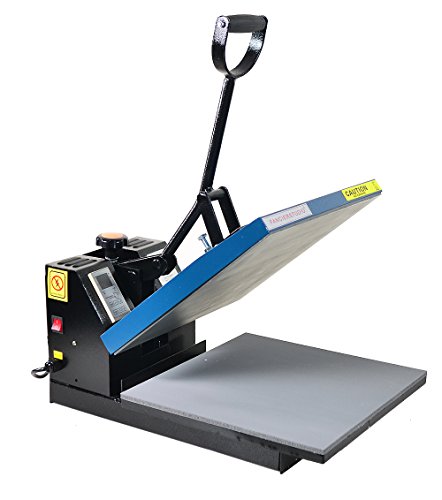
The Fancierstudio provides the straightforward flat-press format many apparel businesses start with. Its stated 15×15 heat press sheet gives a broad working area for common shirt designs, while the electronic controls cover a temperature range of 0 to 699°F and a timer range of 0 to 999 seconds. The product information also identifies adjustable pressure, a silicone-gel base board, and a Teflon coating on the heat platen.
The supplied electrical details are 110V and 1,800W. Wattage describes electrical power, not verified heat-up speed or temperature uniformity, so those conclusions should not be drawn from the number alone. This press has no listed automatic pressing or automatic release function, which keeps its operating format distinct from the HTVRONT models. For a business that wants a manual machine with broad stated controls and does not need mugs, caps, or plates, the simpler configuration may be easier to compare against the actual apparel workflow.
Pros
- Provides a stated 15×15 pressing area.
- Offers adjustable pressure.
- Lists a 0 to 699°F temperature range.
- Lists a 0 to 999-second timer range.
- Includes a silicone-gel base board and Teflon-coated platen.
Cons
- The supplied information does not identify automatic pressing or automatic release.
- The published details do not provide a machine footprint, weight, or temperature-accuracy tolerance.
This model is a reasonable match for an apparel-focused business that prefers manual operation and wants a 15×15 area with clearly stated controls. A business handling repeated cycles with less manual intervention may prefer one of the automatic HTVRONT presses, while a mixed gift catalog needs a multifunction machine instead.
To buy this product, click here.
Buying Guide
Start With the Product Mix
A shirt-focused business should begin with the flat pressing area and the transfer work it expects to handle. The 15×15 machines in this guide provide more stated width than the 12×10 HTVRONT, while the Stahls’ model provides a stated 16×16 area. A business selling mugs, caps, and plates needs a different equipment plan. The Whubefy, Slendor, and VEVOR packages list specialty attachments, but each attachment has its own stated size limits, so a mug attachment should not be treated as a universal tumbler press.
Compare the Pressing Area Carefully
Platen dimensions describe the stated pressing area, not the machine’s overall footprint or guaranteed usable heated area. A 15×15 press may be a practical starting point for common apparel designs, while a 16×16 press provides a little more stated working area. The 12×15 multifunction units give up width compared with the 15×15 models but add specialty equipment. Match the dimensions to the artwork and products that actually make up the catalog.
Choose the Operating Mechanism
Manual flat presses such as the Fancierstudio leave the operator responsible for the pressing cycle. The HTVRONT models identify automatic pressing and release, with some versions adding slide-out loading and preset modes. Stahls’ uses an auto-clam format, while Whubefy, Slendor, and VEVOR identify swing-away arms. These mechanisms change how an item is positioned and how the upper platen moves. Automatic operation should be judged by the exact function stated, rather than treated as proof of faster production or lower labor needs.
Look for Pressure Information
Pressure controls are especially relevant for a business using different garments, transfers, or thicker items. The HTVRONT Auto Heat Press 2 lists adjustment up to 80 kg (170 lb), while the Fancierstudio, Slendor, and VEVOR identify manual pressure adjustment through a control. The HTVRONT 12×10 displays pressure, but a display is not independent verification of accuracy. A pressure knob also does not provide a known PSI figure unless the manufacturer supplies one.
Review Temperature and Timer Controls
Digital controls allow a user to set time and temperature, but a displayed setting does not establish actual platen accuracy or uniformity. The Fancierstudio lists 0 to 699°F and 0 to 999 seconds. The Slendor lists 0 to 482°F and 0 to 999 seconds, while the VEVOR lists 0 to 450°F and 0 to 999 seconds. Those are useful published ranges, yet the correct setting still depends on the transfer and substrate instructions. Avoid selecting by maximum temperature alone.
Plan the Workspace and Electrical Setup
Platen size is only one part of placement. Swing-away machines need room for the upper assembly to move, and multifunction presses need storage or access for their attachments. The Fancierstudio lists 110V and 1,800W, the Whubefy lists 110V and 900W, and the Stahls’ model lists 110V. These electrical details should be checked against the intended workspace, but they do not establish circuit compatibility or production capacity by themselves. The published information does not provide complete footprint and weight data for every selection, so those details should be confirmed before ordering.
Separate Primary Equipment From Specialty Tools
A mini press can be useful for small details, yet it should not replace a primary press for a business applying broad apparel graphics. The final selections here focus on complete flat or multifunction machines. Specialty attachments are worthwhile when the business actually sells the products they support. A larger list of attachments is not automatically a better purchase, especially if the main work is shirts and the attachments will sit unused.
Best Heat Press for Small Business FAQ
What Size Heat Press Is Most Useful for a Small Business?
A 15×15 press is a practical reference point for many apparel-focused businesses because it provides a stated square working area for common shirt designs. A 16×16 model gives more stated area, while a 12×10 model takes a smaller approach. The best size depends on the artwork and products being sold, not on platen size alone.
Is an Automatic Heat Press Better for a Small Business?
An automatic press can change the operating sequence by applying the press cycle and releasing the item automatically, as described for the HTVRONT models. That may suit a business that prefers those controls. It does not prove higher output, labor savings, or better transfer quality. Compare the exact automation, pressure information, clearance, and settings rather than relying on the word “automatic.”
Should a Small Business Buy a 5-in-1 or 8-in-1 Press?
A multifunction press makes sense when the business sells several supported products. The Whubefy lists mug, cap, and plate attachments, while the Slendor and VEVOR list their own mug, cap, and plate formats. Check the exact diameter, capacity, and plate sizes because an attachment for an 11 oz mug does not establish compatibility with every mug or tumbler.
Is a 15×15 Press Large Enough for Hoodies?
A 15×15 platen provides a stated working area, but that measurement does not establish how every hoodie, transfer, or thick item will fit. The HTVRONT Auto Heat Press 2 specifically lists clearance up to 4.5 cm (1.77 inches), while other machines have different or unspecified clearance information. Compare the garment, artwork size, and published clearance before selecting a press.
What Does Adjustable Pressure Mean on a Heat Press?
Adjustable pressure means the machine provides a way to change the applied pressure, such as a knob or a stated automatic pressure system. It does not automatically provide a measured PSI value or prove pressure consistency. The HTVRONT Auto Heat Press 2 publishes a pressure figure, while the Fancierstudio, Slendor, and VEVOR list adjustment without the same numeric detail.
Can One Heat Press Handle DTF, HTV, and Sublimation?
A flat heat press may provide the heat, timer, and pressure controls used in several transfer processes, but general heat-press capability is different from process optimization. The transfer manufacturer, substrate, coating, and required settings still matter. The supplied product information names DTF, HTV, sublimation, or heat-transfer projects for some models, but it does not establish universal compatibility with every material.
Does a Swing-Away Press Need More Space?
A swing-away mechanism moves the upper heating assembly aside during loading, so the workspace must allow that movement. The Slendor, VEVOR, and Whubefy models identify 360-degree swing-away designs. The supplied information does not provide complete footprint measurements for each machine, so buyers should confirm the overall dimensions and clearance required for the selected model.
What Should a Small Business Check Before Ordering?
Check the exact platen size, press mechanism, pressure controls, temperature and timer ranges, automation, clearance, attachments, voltage, wattage, and overall dimensions. Also verify that the listed applications match the products being sold. A shirt business may need a 15×15 automatic or manual flat press, while a mixed gift catalog may benefit from a multifunction unit with clearly specified mug, cap, and plate attachments.
Final Verdict
The HTVRONT Auto Heat Press 2 is the strongest overall fit for this small-business list because the supplied information gives a clear picture of its working format. It has a stated 15×15 pressing area, adjustable pressure up to 80 kg (170 lb), listed clearance up to 4.5 cm (1.77 inches), automatic pressing and release, an adjustable screen, and a 15-minute auto shutoff. Those characteristics align closely with a business using one primary flat press for apparel and thicker related items.
The alternatives serve distinct needs. Stahls’ Hotronix provides a stated 16×16 area and auto-clam format, Fancierstudio keeps the operation manual with broad stated controls, and the other HTVRONT models add preset or slide-out functions. Whubefy, Slendor, and VEVOR are better matched to catalogs that genuinely include mugs, caps, and plates. The compact 12×10 HTVRONT is worth attention where the smaller pressing area fits the product line. Match the machine to the actual catalog, available workspace, electrical information, and level of automation required.
